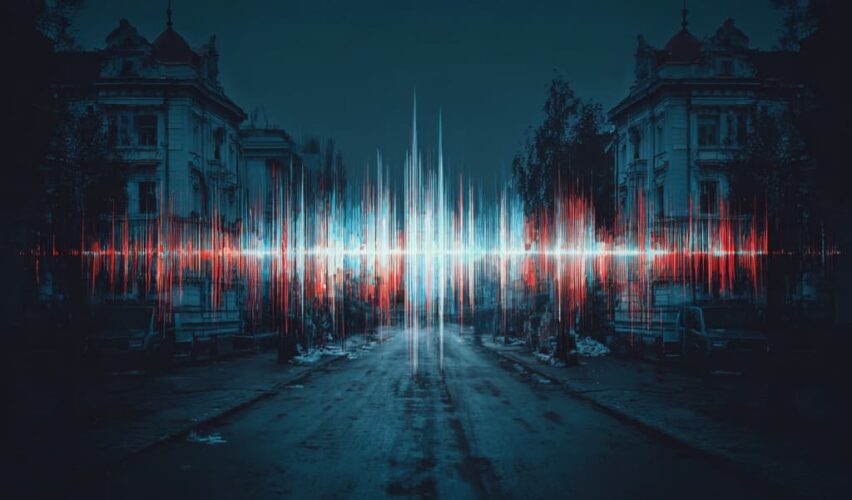
A city makes sound even when people stop paying attention to it. Tires moving across wet asphalt, subway doors closing, fragments of conversation, traffic signals, footsteps in an underpass, ventilation systems, distant sirens, the metallic scrape of a tram, rain falling on a bus shelter – all of these sounds are usually treated as background noise. For an electronic musician, however, that background can become raw material. In modern music, the city is increasingly becoming a living instrument, one that cannot be bought as a plugin and cannot be repeated in exactly the same way twice.
Electronic music has always been connected to technology, but not only to synthesizers, drum machines, and computers. A major part of its history is the ability to hear something unusual inside ordinary sound. When a producer records the street, they are not simply collecting dirty audio. They are capturing environment, movement, time, and accident. In that sense, urban noise gives a track something that polished digital sample libraries often lack: character.
Why Urban Noise Feels More Alive Than Ready-Made Samples
A ready-made sample is convenient. It is clean, labeled, organized, and easy to place inside a project. That is exactly why many tracks made only from sample packs can begin to sound interchangeable. The kick may be strong, the hi-hat may be sharp, the atmosphere may be technically correct, but the sound often carries no memory of a real place.
Street recordings work differently. A train brake is not just a metallic tone. It contains air, distance, dirt, pressure, and context. A crowd outside a club is not just human noise. It has rhythm, mood, language, and temperature. A market at closing time can contain accidental percussion, low drones, plastic bags, footsteps, laughter, and short melodic fragments from radios or phones.
These sounds do not arrive perfectly prepared for music. They need editing, cutting, filtering, stretching, layering, and sometimes serious cleaning. But their imperfection is exactly what makes them valuable. They can make an electronic track feel less like a grid and more like a place.
Field Recording as a Form of Listening
The practice of recording real-world sound is often called field recording. It can happen in nature, in industrial spaces, in public transport, in abandoned buildings, or in the middle of a crowded street. In electronic music, field recording is not only a technical process. It is also a form of listening.
A musician who records the city must slow down and notice details that most people ignore. Which alley has the strongest echo? How does an escalator sound when the station is almost empty? What happens to traffic noise after rain? Where does a street musician’s melody blend with construction work? Which sounds repeat rhythmically without being designed as music?
This changes the role of the producer. Instead of creating everything from scratch, the producer becomes a collector, editor, and translator of the surrounding world. The city already plays. The musician decides what to hear, what to isolate, and how to turn it into structure.
From Noise to Rhythm
One of the easiest ways to use street sound in electronic music is rhythm. Cities are full of patterns. Crosswalk signals repeat. Train doors close in cycles. Heels on pavement create sharp percussion. Machines pulse. Elevators hum. Buses release air in short bursts. Even traffic has a kind of unstable groove.
A producer can cut these sounds into small pieces and use them like drums. A closing gate can become a snare. A subway click can become a hi-hat. The thump of a suitcase on stairs can become a kick layer. Once edited and placed into a rhythm, the original source may no longer be obvious, but it still gives the track a physical texture.
This is one reason street noise works so well in techno, ambient, experimental club music, and sound art. It can make rhythm feel connected to real movement. The beat is no longer only a digital loop. It carries traces of walking, waiting, commuting, working, and passing through the city.
Atmosphere, Memory, and Place
Not every urban sound has to become percussion. Sometimes the most powerful use of city noise is atmospheric. A low recording of traffic can sit under a track like a distant drone. Rain can soften the edges of a mix. Voices can appear as blurred fragments, not as lyrics but as memory. A station announcement can create a sense of location without explaining anything directly.
This kind of sound design can make electronic music feel cinematic. The listener may not know exactly where the recording was made, but they feel that the track belongs somewhere. It has walls, streets, air, and distance. It does not float in a neutral digital space.
For many artists, this is also a way of preserving personal geography. A producer can record the neighborhood where they grew up, the station they pass every morning, the street outside a studio, or the market that defines a city’s rhythm. These recordings become emotional documents. They turn a track into more than a composition. They turn it into a small archive of place.
The Beauty of Imperfection
Urban sound is rarely clean. There is wind, distortion, overlapping noise, sudden interruptions, and unwanted frequencies. In traditional recording, these problems are often treated as mistakes. In experimental electronic music, they can become part of the language.
A distorted siren can be stretched into a pad. A bad phone recording can become a ghostly texture. A broken microphone can create a grain that feels impossible to design artificially. Noise becomes useful because it resists full control.
This matters because electronic music can easily become too polished. Modern production tools make it possible to correct almost everything. Timing can be fixed, pitch can be adjusted, noise can be removed, and sounds can be made perfectly wide, loud, and clean. But perfection can also flatten emotion. Street recordings bring back friction. They remind the listener that sound comes from bodies, surfaces, machines, weather, and chance.
How Street Noise Changes the Listener
When city noise becomes music, it also changes how people listen outside the track. After hearing a subway sound used as percussion or traffic turned into a drone, the listener may begin to notice the city differently. Ordinary noise becomes less disposable. The environment starts to feel like a composition that is always changing.
This is one of the strongest artistic effects of using urban recordings. It blurs the line between music and daily life. The track does not end completely when the headphones come off. Some part of it continues in the street.
For electronic music, this is especially important. The genre is often imagined as artificial, synthetic, and detached from place. But urban field recordings prove the opposite. Electronic tracks can be deeply connected to physical environments. A laptop, sampler, or modular system does not have to remove music from reality. It can become a tool for hearing reality more sharply.
The City as Co-Author
The most interesting thing about using street noise is that the musician never controls everything. A passing car, a sudden voice, a broken light, a dog barking, a train arriving early – these details enter the recording without permission. The city becomes a co-author.
That does not mean the music is random. The artist still shapes the material, chooses the form, and decides what remains. But the source sound brings its own behavior. It pushes against the clean logic of the studio. It adds surprise.
That is why the sound of the city remains so powerful in electronic music. It gives producers more than texture. It gives them life, accident, place, and memory. In a world full of perfect digital sounds, the street still has something no software can fully imitate: the feeling that music is already happening around us, waiting for someone to listen.